Arashino residence and workshop
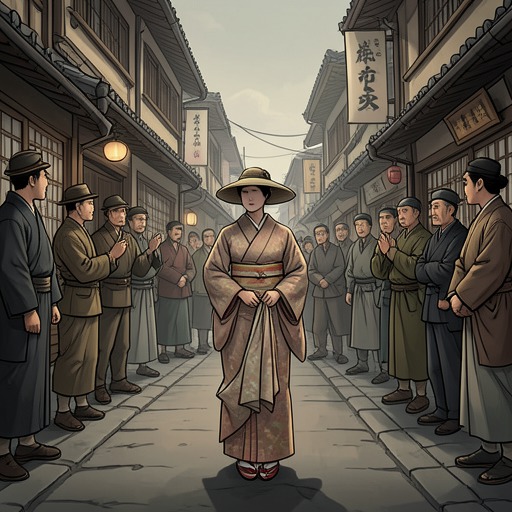
Memoirs of a GeishaThe Arashino residence and workshop is the home and place of work where Sayuri spends the war after Nobu arranges refuge with his friend Arashino Isamu. About five kilometers upstream from Gion, on the shallows of the Kamo River, it offers her shelter but not escape from deprivation: the family sews parachutes, sleeps on futons on the workshop floor, and endures hunger, air raids, and the collapse of Sayuri’s former life as a geisha. In this setting, the workshop’s work and rooms become a measure of how war remakes both material culture and personal identity.
Location and Work
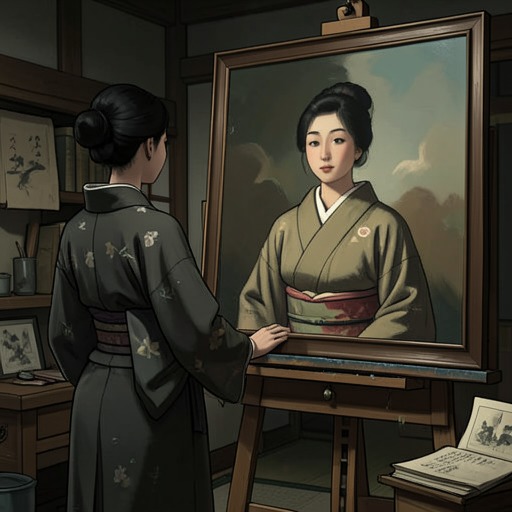
Before the war, Arashino Isamu, his wife, and daughter made kimono in the Yuzen style for which he was known. The workshop’s skilled use of silk made it useful to the wartime economy in a different way: kimono makers were put to sewing parachutes. Nobu presents the work as something Sayuri could learn quickly, and the Arashino family agrees to take her in. He writes the home’s address on a piece of paper and promises to make the necessary arrangements with the authorities. The place thus enters Sayuri’s life not as a destination she chooses independently, but as a specific refuge secured through Nobu’s connections.
The workshop’s function changes again after Japan’s surrender. Within a year, Arashino is encouraged to resume making kimono. Sayuri, who knows how to wear them but not how to make them, is assigned to tend the boiling dye vats in the basement of the workshop annex. The return to kimono production does not restore her old place in the world: she performs the unpleasant, labor-intensive work of dyeing rather than returning to the profession and appearance she once possessed.
Refuge and Wartime Routine
The residence is one of the few places available to Sayuri when Gion’s geisha struggle to find shelter in the war’s final weeks. She later recognizes how unusual her good fortune was: hundreds of geisha seek a safe place, but only a few find one. That knowledge deepens the debt she feels toward Nobu, who arranged her refuge, and toward the family that receives her.
Her days are spent sewing parachutes with the Arashinos. At night, she sleeps beside their daughter and grandson on futons spread over the workshop floor. There is too little charcoal for warmth, so the household burns compressed leaves, newspapers, and magazines. Food is scarcer still: the family eats soybean dregs normally fed to livestock and a preparation made by frying rice bran in wheat flour, as well as occasional potatoes, sweet potatoes, dried whale meat, seal sausage, and sardines. The catalogue of substitutes makes the workshop feel less like a sanctuary from wartime conditions than a small domestic space forced to absorb them.
The strain is visible in Sayuri’s body. She grows so thin that she believes people on the streets of Gion would no longer recognize her. When the Arashinos’ young grandson, Juntaro, cries from hunger, Arashino sometimes sells a kimono from his collection. The family’s need turns treasured garments into provisions, one layer of security exchanged for another. Sayuri understands this piecemeal surrender as an “onion life”: each removal brings more deprivation and grief.
Air Raids and Separation
In the spring of 1944, only three or four months after Sayuri arrives, the household witnesses its first air raid. From the Arashino home, the family sees the silhouettes of bombers overhead and the defensive fire rising to meet them. They fear Kyoto will be set ablaze, an outcome Sayuri imagines as the destruction of a city too delicate to recover. The bombers pass over, but the danger does not become abstract: on many evenings the moon reddens from fires in Osaka, and ash drifts as far as Kyoto, about fifty kilometers away.
The view from the workshop sharpens Sayuri’s anxiety for people beyond it. She worries about the Chairman and Nobu, whose company is based in Osaka and who have homes there as well as in Kyoto. She also thinks of her sister Satsu, from whom she has been separated since Satsu ran away. While walking Juntaro along the river and throwing stones back into the water, Sayuri realizes that Satsu is unlikely to return to Kyoto to find her. Poverty makes travel to a distant city nearly impossible, and Satsu could not write to the Nitta okiya without knowing its name. The residence gives Sayuri safety from immediate displacement, but it cannot close the distance between her and the family she has lost.
Work After the War and Lasting Change
After surrender, the workshop’s renewed kimono production brings a different hardship. The dye vats are heated with tadon, coal dust bound with tar, whose burning stench makes Sayuri’s work horrid. Arashino’s wife teaches her to gather leaves, stems, and bark for dyes, but one unidentified material causes Sayuri’s skin to peel and stain darkly. Her once-carefully tended hands become rough and bruise-colored, a bodily record of the work she performs and of her distance from her former life.
When her hands are damaged, Sayuri is reassigned to gather spiderworts, whose juice is used to paint silk before it is masked with starch and dyed. The move from the basement vats to the plants around ponds and lakes offers some relief to her skin, but not an easy escape from labor: insects attack her as she gathers the flowers, and she accidentally steps on a frog. The workshop’s work therefore reaches outward into the surrounding landscape, connecting the production of dyed silk to the plants and materials Sayuri must collect herself.
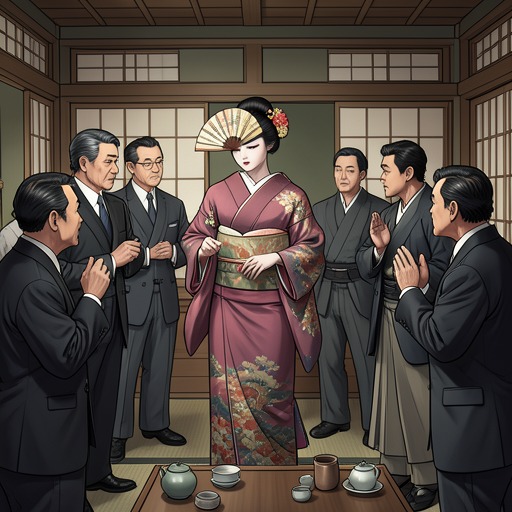
The residence and workshop holds together several versions of Sayuri’s life without reconciling them. It is a refuge arranged by Nobu, a shared home where the family endures wartime hunger, a workplace converted to military production, and a postwar site of renewed craft where Sayuri’s hands are altered by labor. Its return to making kimono does not mean that the past has returned; the same material tradition now carries the marks of scarcity, wartime conversion, and the changed person who helps restore it.